
What to expect on a gorilla trekking day.
Gorilla trekking is often described as a life-changing safari, but the day itself is highly structed, physically demanding, and emotionally rewarding. Whether you are trekking in Rwanda’s Volcanoes National Park or Uganda’s Bwindi Impenetrable or Mgahinga Gorilla National Parks, the basic frame work of the day remains the same. Understanding the schedule, the physical requirements, and the crucial rules ensures you are fully prepared for this unforgettable encounter with the wonderful Mountain Gorillas.
1.The Morning Start (6:00 AM to 8:00 AM)
The gorilla trekking day begins before morning. You must be ready to leave right after breakfast to be able to get to the park’s headquarters on time.
Breakfast and Transfer: Generally, lodges around the parks are very accommodating and provide breakfast at early hours, starting from 6:00 AM most of the time, to ensure enough time for the transfers. The park headquarters can be between 15 minutes to more than one hour away from you depending on where your lodge is and which sector your permit has been allocated. Knowing how far the transfers will take you is very crucial and a good time for confirming it is the night before.
The Trekking Briefing (7:30 AM – 8:00 AM): After getting to the park headquarters (Kinigi in Rwanda or Buhoma in Uganda), you will be welcomed by the park staff and can enjoy some coffee and tea. The park rangers then give a mandatory orientation. This is where you learn the essential rules.
One should keep a distance of at least 7 meters from the gorillas.
One has to wear a surgical mask in the appearance of gorillas so as to prevent the spread of human diseases.
The time for a look at a gorilla family is only one hour after the gorillas are found.
After which, the groups will be formed, each group consisting of eight members, with assignments of one habituated gorilla family per each group to follow Continued: Small groups of eight individuals are formed, and each group receives a particular habituated gorilla family to track.
2. The Preparation and Starting the hike (8:30 AM – 9:00 AM)
Once the briefing has been completed, it is time to take care of the necessary pre-trek steps.
Porters and Walking Sticks: It is a very important step to be done, and it is also highly recommended for all trekkers no matter how fit they might be. In addition, the porters, being local people from the community, will help you carry your daypack that contains water and cameras, and the most important thing is that they will be a supportive hand for you during the trek that will help you with balance if the road is slippery. Besides that, hiring a porter will give a great boost to the area’s economy as well as make the walk very easy for you. There will be no charge for walking sticks and if there is slippery ground, one must be carried immediately.
Meet Your Team: The faces of your dedicated tracking team will be shown to you in person. Along with the park ranger (who is carrying a gun for protecting against buffalo and other threats), the track team will also consist of the trackers. These trackers are the ones who had to go ahead before evening to find the point where the gorilla family that they were going to take you to had stayed the night and where they had taken their path.
Going into the jungle: After all the groups are complete, you are driven to the trailhead. Depending on where the trackers found your assigned family, the distance to the trailhead could be either very short or quite long. As soon as you step into the dense, humid rainforest, the trek is what we call officially started.
3. The Trek: The Physical Challenge (9:00 AM – Anytime Between 12:00 PM and 3:00 PM).
The unpredictability of the duration and difficulty of the trek is what makes it the central challenge of the day.
The Terrain: Make sure you are physically ready for the hike. The trail features steep and slippery slopes, thick undergrowth that sometimes requires the ranger to clear the way with a machete, and high altitude (especially in Mgahinga and Volcanoes). You will be scrambling over muddy banks, weaving through thick vines and climbing uphill for the extended periods.
The Duration Factor: Trekking time can from 30 minutes (if the gorilla family is near the park boundary) and as long as 8 or 9 hours (if the family is far up the mountain). Only your fitness level can be the difference between you enjoying the journey or just enduring it. It is very important that you regulate your speed, keep drinking water, and receive support from your porter. The physical strength required is what makes the last moment seeing so precious.
4. The Encounter: The Magical Hour (One Hour Only).
The immediate effect of the gorilla trackers’ signal that the family is close is a complete change in the atmosphere.
Final Approach: You give your walking sticks and backpacks to the porters and carry on with only your camera and guide. The ranger will help the final rules: wear your mask, stay quiet, and keep the distance of 7 meters. After that, you will follow the family into the clearing or the woods.
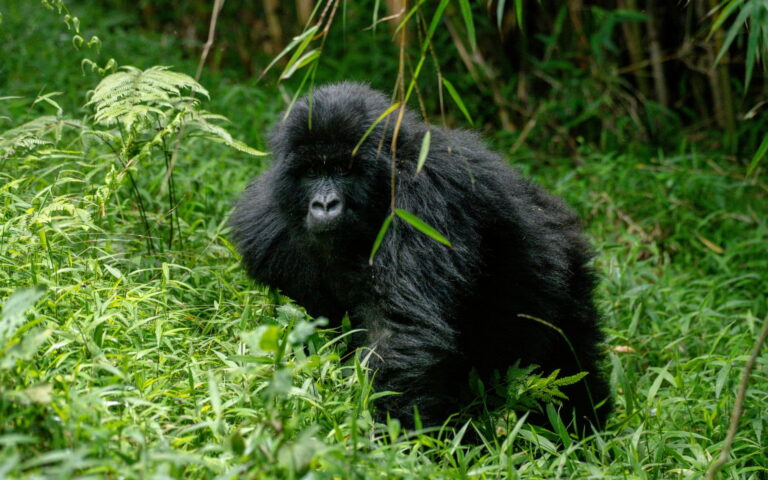
Observing the Family: The next 60 minutes are just unbelievable. You will see the gorillas in their natural environment: the big Silverback male dominating the family; the mothers feeding their babies; the young gorillas playing, tumbling, and mock-fighting in the bamboo shoots. The sound of the food being chewed and the sight of the hand and eye which look like those of a human are very touching. Be sure to focus on the experience of the moment but still take photos which do not use flash.
Respecting the Time Limit: The one-hour limitation is very strict and is only for the purpose of protecting the gorillas from being stressed as well as catching an infection. When the time comes to an end, the ranger will quietly take you away from the scene of the family.
5.The Return Journey and Conclusion (Post 1:00 PM).
The way back is usually less difficult but can still drain your energy if your trek went for a long period of time.
Hiking Back: After gathering your gear, you set off on the hike back to the trailhead. Usually, you will be driven back to the park headquarters where you get a certificate as proof of your accomplishment after the trek.
Tipping and Goodbye: Here is the time to give money to your guide, ranger, and your porter most of all. For the local communities, tipping is a very important source of income. At last, you are driven back to your lodge for a late lunch or you can go on to your next safari destination with the memory of the encounter that only a handful of people ever experience. Gorilla trekking is tiring, demanding, and giving a muddy footstep, yet it is worth it with WildApes Safaris.