
What is Guarantee to see chimpanzees in Rwanda.
When travellers plan a primate safari to Rwanda, the most common question they ask is: ‘’Can you guarantee that I see the chimpanzees? ’’Unlike a zoo where animals are in enclosures, chimpanzees in Rwanda live in vast, mountainous rainforests. While nature never offers a 100% legal guarantee, Rwanda provides one of the highest success rates in Africa, typically over 95%. In this guide, we will explain what the ‘’guarantee’’ is so high, how the tracking process works, and what factors influence your changes of unforgettable encounter in the ‘’Land of Thousand Hills.’’
1.The power of Habituation: Preparing the way.
The main reason why sightings are also reliable in Rwanda is a process called ‘’Habituation.’’ This is the long-term project where researchers and rangers spend years visiting a specific chimpanzee troop every day until the animals become comfortable with the human presence.
Trust Between Man and primate: In Nyungwe Forest National Park and Gishwata Mukuru National Park, several communities of chimpanzees have been habituated. Because these chimps no longer view humans as a threat, they continue their daily activities grooming, playing and feeding even when tourists are nearby. This habituation is the ‘’foundation’’ of the guarantee. Because the rangers know exactly where these specific families live and how they move, they can lead you to them with the incredible accuracy.
2.The Role of the ‘’Advanced Trackers’’
The secret weapon behind Rwanda’s high success rate is the team of the advanced trackers. Long before you finish your morning coffee at the lodge, these professional trackers are already deep in the forest.
Early morning Reconnaissance: These trackers head to the spot where the chimpanzees were last seen the previous evening. Since chimpanzee build new nests every night, the trackers look for these nests and listen for the loud ‘’pant hoot’’ calls that chimpanzees make when they wake up in the morning. Once the trackers locate the troop, they radio the guides who are with the tourists. This ‘’scout and radio’’ system is what ensures that you are not just wandering aimlessly; they are being guided to a specific, live location.
3.Nyungwe forest: the main tracking hub.
Most chimpanzee tracking in Rwanda happens in Nyungwe Forest National Park, a prehistoric rainforest that is a home to 14 primate species.
Cyamudongo vs Main Forest: There are two main areas for tracking in Nyungwe. The Cyamudongo forest patch is smaller and more isolated, which often leads to a higher sighting ‘’guarantee’’ because the chimps have a smaller area to move around in. the main Nyungwe forest is much larger and offers a more rugged adventure. At WildApes Safaris we often recommend Cyamudongo for those who want a ‘’statistically higher’’ chance of a quick encounter, while the main forest is perfect for those who want a deep jungle experience.
4.understanding chimpanzee behaviour: the ‘’Moving Targets’’.
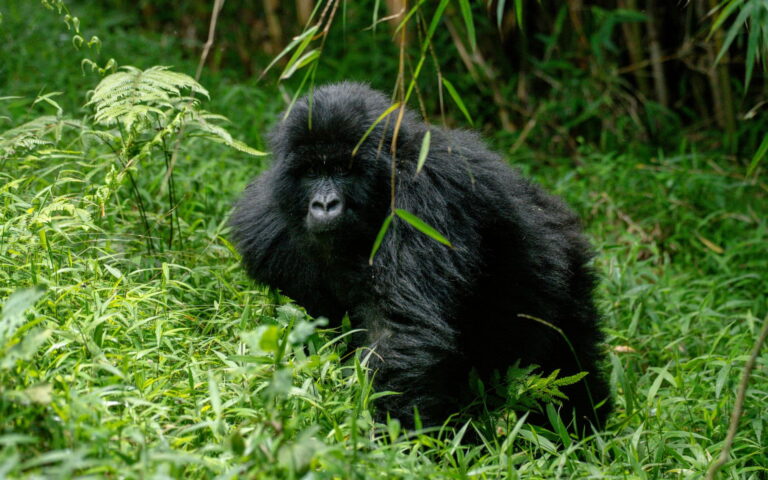
To manage expectations, travellers must understand that chimpanzees are much more active and then mobile than mountain gorillas. Gorillas are ‘’sedentary’’ (they sit and eat), while chimps are ‘’arboreal’’ and highly energetic.
The chase: Sometimes the ‘’guarantee’’ depends on your ability to keep up. Chimpanzees can move quickly through the canopy or across the forest floor. You might find them sitting quietly in a fig tree for an hour, you might find yourself in a ‘’fast paced trek’’ as they move toward a new food source. The high success rate in Rwanda is based on finding the troop, but the quality of the sighting whether they are on the ground or high in the trees is determined by the animal’s mood and the time of the year.
5. Seasonal factors: Food availability.
In the rainforest, food is the map that chimpanzees follow. Their movements are dictated by which fruits are ripening in which part of the forest.
The best timing: During the rainy seasons (March to May and October to November), food is often more abundant at lower altitudes, which can actually make the ‘’guarantee’’ even stronger because the chimps do not have to travel as far or as high to find a meal. During the drier months, thy many moves deeper into the valleys to find water and fruits, making the trek longer. However, because the trekkers are our every day they adjust their starting points based on these seasonal shifts.
6.Physical fitness and the ‘’Human factor.’’
While the guides will do everything in their power to find the chimps, the ‘’guarantee’’ of a successful trek also depends on the traveller.
Be prepared for the trek: The rainforest can be slippery, steep, and dense. If a traveller is not physically able to hike for 2 to 4 hours, hey might miss out on the sighting even if the trackers have located the animas. We recommend wearing sturdy hiking boots with good grip and then using a walking stick provided by the park. By being physically prepared, you ensure that when the guide says, ‘’They are just over the ridge,’’ you have the energy to complete the final leg of the journey.
7. What happens if you do no see them.
In the extremely rare event (less than 5% of cases) that the chimpanzees are not found perhaps due to the sudden storm that makes them hide or an unusually long migration the Rwanda Development Board (RDB) and WildApes Safaris have protocols in place.
The policy: Usually if the trackers, fail to locate the chimps entirely, guests may be offered a second trek the following day (subject to permit availability) or a partial refund of the permit fee according to the park’s specific terms. However, it is important to remember that the ‘’thrill of the hunt’’ is part of the safari experience. The vast majority of our guests leave Rwanda having spend a magical hour watching our closest cousins in their natural habitat.
In conclusion, the guarantee of seeing chimpanzees in Rwanda is majorly on the dedicated conservationists. It requires patience and a bit of effort, but the moment you see a chimpanzee looking back at you with intelligent eyes, you will know it was worth every step with unforgettable safari memories. Contact us to book.