
Is gorilla trekking in Rwanda easier than gorilla trekking in Uganda.
One of the most common questions asked by anyone planning a primate safari is: “Which country gorilla trekking is easier?” Without a doubt, Rwanda and Uganda both allow you to see the same species of mountain gorilla, but the actual experience of encountering the gorillas is very different in each country. Some tourists like the well-organized and not very strenuous hiking in Rwanda, whereas others enjoy the thrilling “deep jungle” of Uganda. Here is a report comparing the countries based on the differences in terrain, altitude, and logistics to help you decide the one that best suits your fitness level.
1. Terrain and Forest Density: The “Open” vs. The “Impenetrable”
The single biggest factor which sets apart the two countries is the kind of forest you will be walking in.
Rwanda (Volcanoes National Park): The forest here consists mainly of bamboo. Bamboo is kind of “open” as far as the rainforest is concerned. This means that as you are going through the forest, you will be able to see quite far in some places, and the rangers will not have to cut down as many branches to make a path. The ground is mostly “open” in this way, so it is easier to pick your footsteps.
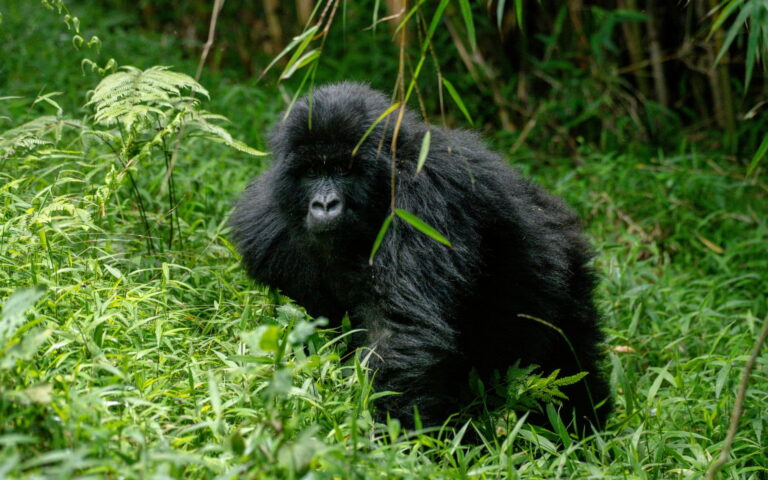
Uganda (Bwindi Impenetrable Forest): The forest is literally “impenetrable”. It is a very old, thick rainforest with lots of vegetation on the ground and at different heights. Here you will be walking amidst a plethora of ferns, vines and other bushes, and the rangers will barely be able to keep up with their machetes to clear the path. Hiking through such dense forest may be more physically demanding as you have to constantly bend to duck under branches and step over roots.
2. The Altitude Factor: Breathless in Rwanda
In terms of forest, Rwanda has the “clearer” one, yet the altitude can be higher there, and sometimes this may result in the hike feeling more tiring for a person.
Rwanda: Volcanoes National Park is situated at the foothills of the huge volcanoes. Most of the hikes start at an elevation of around 2,500 meters and you can go as high as 3,500 meters.
Uganda: Bwindi is located at a slightly lower altitude, generally between 1100 and 2000 meters. While it is still high, the air feels ‘’thicker’’ and easier to breathe for most people. However, Uganda, makes up for the lower altitude with its ‘’endless hills.’’ In Bwindi you do not just climb up once; you often go down into a deep valley and then back up a steep ridge, repeating this several times before you find the gorillas.
3. Logistics and Drive Times: The “Easy” Arrival
If we take “easy” to mean how little time you are required to spend driving in a car before you start your trek, then there can be no doubt that Rwanda is the winner.
Rwanda: It takes only 2.5 to 3 hours by car to get to the park from Kigali International Airport. The roads are great tarmac ones. You can land in the morning and be at your lodge by lunch time. The entire trip will therefore be less fatiguing.
Getting to Bwindi from Entebbe International Airport in Uganda is almost like a main adventure by itself. You have to travel about 9 to 10 hours by road, and these roads can be bumpy and tiring. Flying to Bwindi is possible but it will add to your costs. It is the long road trip within Uganda that many consider the “toughest” part of the whole gorilla tracking experience.
4. Tracking Success and Duration.
Another aspect that can be used to measure the “ease” of a trek is the time spent walking before you finally get to see the gorillas.
Rwanda: Since the park is smaller and the bamboo forest is easier to navigate, it is not surprising that gorilla treks in Rwanda are often (but not always!) shorter. Most groups will find their gorillas within 2 to 4 hours of walking. Thanks to good park organization, trackers generally have an accurate idea about the whereabouts of the gorilla families after the morning briefing.
Uganda: Bwindi is a huge forest with four different sectors for gorilla trekking. Depending on the sector you are visiting, the trek can be very long. In Uganda, it is not unusual for gorilla treks to last 5 to 7 hours. The gorillas are freer to move and so they can go far into the valleys. In fact, the toddlers sometimes play in the water, which means the children get to wash and the parents can rest. This results in a significantly longer day of hiking.
5. Managing the “Toughness”: Using Porters
Luckily, the two countries are offering the exact same “secret weapon” which is able to help making the trek more comfortable: Porters.
Hiring a porter in Rwanda or Uganda will be roughly US$20. They will not only carry your heavy backpack but also provide you with a physical “pull” or “push” whenever it gets muddy or the slope steep. If you want to convert a “hard” trek into a “manageable” one, using a porter is the best choice. Speaking physically, a porter is highly recommended for the trekkers who are not very fit and is a must for the elderly or anyone with a disability in both Rwanda and Uganda.
6. The Verdict: Which gorilla trekking is Easier?
Because of shorter driving times from the airport, the more open bamboo forest, and the slightly more organized park infrastructure, Rwanda is generally considered “easier”. The other consideration that plays in favor of Rwanda is that it will suit the travelers who do not have much time, or who prefer to have a more luxurious “logistics” experience.
Adventurers take the side of Uganda. The thick jungle and long travelling days make it more physically demanding yet the permits there are much cheaper ($800 as compared to $1,500 in Rwanda). Some people argue that the “toughness” of the Ugandan forest made the final face to face with the gorillas a more true and intense moment.
Summary: Comparison at a Glance
Terrain: Rwanda (Open Bamboo) vs. Uganda (Thick Rainforest).
Altitude: Rwanda (Higher, thinner air) vs. Uganda (Lower, more hills).
Travel Time: Rwanda (3 hours) vs. Uganda (9 hours).
Cost: Rwanda ($1,500) vs. Uganda ($800).
In conclusion Rwanda is more suitable not only for those who are physically less able but also for those who seek comforts on their trips. Uganda, on the other hand, caters to the budget traveler and the adventure/rough it forests lovers.