


How many people are allowed to do gorilla habituation.
Generally, gorilla trekking is considered the highlight of a wildlife safari by most travelers, giving them the opportunity of a rare one-hour personal encounter with a gorilla family which has been habituated. Nevertheless, only a handful of people opt for an even deeper, more private and longer time experience the Gorilla Habituation Experience (GHE). This exclusive safari activity, at present, is available only in Uganda’s Bwindi Impenetrable National Park and, therefore, standard trekking, which already has a very limited number of tourists, imposes an even more stringent limit on the number of visitors, thus highlighting the fragility and conservation priority of the forest. It is very important to comprehend the clear difference in the number of people allowed for this ultimate primate adventure in order to make the right plan.
1.Defining the Experience: Habituation vs. Trekking.
In order to understand the limits on the GHE, it is first necessary to comprehend the differences between them and that habituation is fundamentally different from standard gorilla.
What is Standard Trekking? Normal gorilla trekking refers to the visits to the families that are already fully habituated with the human beings by the time of habituation, the gorillas are familiar with the presence of a human being, this process takes about three years. Visiting and being in the presence of the gorillas is limited to one hour and, generally, the gorillas do not pay attention to the visitors and, therefore, they continue to feed and interact naturally.
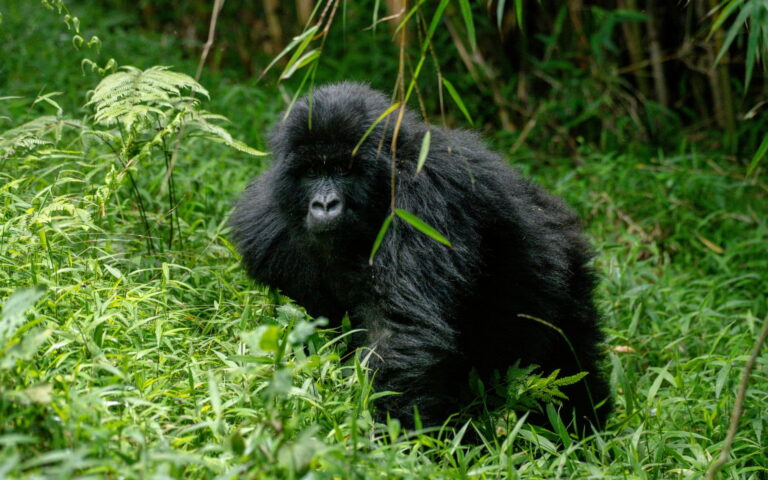
What is the Habituation Experience (GHE)? GHE permits the tourists to work with the scientists, conservationists, and rangers who are actively habituating a wild gorilla family. These families are usually scared, quiet, and are not that friendly with humans. Tourists, as part of the GHE, get a chance to watch silently the complex process, whereby gorillas are gradually becoming accustomed to human observers. This is a behavioral study, not just a tourist viewing.
2. The Extremely Strict Quota: Four People, Four Hours
The most important difference between the GHE or standard trekking is that of the visitor quota and the time allocated. The difference is very large and the main reason for this lies in the need of minimizing disturbance to the gorillas during their sensitive transition phase.
The Numerical Limit: Only four permits are allocated per gorilla family that is in the habituation process for a day. Hence, the number of people is half that for standard trekking which is eight people.
The Time Advantage: In exchange for the higher cost and grater difficulty in securing a permit, those four people are allowed to spend four hours with the family once it is located, vastly extending the observation period beyond the one-hour limit of standard trekking.
The Daily Total: The habituation experience is mainly facilitated in the Rushaga area of the Southern Bwindi and usually, one or two families are in the process of habituating at any given time. In such a case, the total number of GHE permits available daily in the world is extremely low often just four to eight permits in total.
3. The Conservation Rationale: Why So Few People?.
Reducing the number of visitors to four is a purposeful, scientifically-based conservation tactic aimed at the protection of the fragile habituation process.
Minimizing Stress: Definitely, the small wild or semi-habituated gorilla family would be under stress caused by the continuous presence of the habituation team although it is of gentle nature. In case a great number of humans (eight or more) were to be introduced to the family, it probably would start to run away, hide, or become aggressive thus undoing the work of the last months or years that have brought it slowly but surely to the point of trust. Only by limiting the group to four people can the visual and auditory disturbance be at its lowest level.
Protecting Natural Behavior: The ultimate goal of habituation is not merely for tourism to follow; it is essentially to enable the scientists to understand the gorillas’ natural feeding, social structure, and general well-being. A big group can very much influence or completely change the gorillas’ way of feeding or social patterns. However, four people who are walking slowly and are quiet, will not affect the nature of the data to be collected that much.
Reducing Disease Risk: A gorilla family that is less habituated is very sensitive to human presence and potential threats to their health. The limitation to a maximum of four visitors per day significantly lessens the likelihood of disease transmission via air thus, the health of these extremely endangered animals is not at risk during their acclimatization period.
4. Logistics and Cost: Securing the GHE Permit.
Planning a GHE requires exact timing and a lot of money because of the very low quota.
Location, Location, Location: The Gorilla Habituation Experience can hardly be done anywhere but in the Rushaga sector of Bwindi Impenetrable National Park in Uganda. This central point is yet another reason why the daily overall limit is so low. Tourists who want to do the GHE are advised have booked accommodation in this specific sector.
The Premium Price Tag: The GHE permit costs US $1,500 per tourist, which is almost twice as much as the cost of an ordinary Ugandan gorilla trekking permit ($800) but is equivalent to a standard Rwandan permit ($1,500). The additional amount of money helps to cover the costs of the extensive personnel, monitoring, and research that are part of the four-hour experience.
Booking Urgency: Because of the extreme restriction of only four to eight daily slots, GHE permits are even quicker to be exhausted than standard ones. It is highly advised that you reserve your GHE permit no later than 12 to 18 months before the date of your trip, especially when you are planning to travel during the peak dry season (June to September).
In conclusion the extremely low number of participants in the Gorilla Habituation Experience is a direct indication of its conservation value. The restriction to four people a day allows the main concern to be on the gorillas’ welfare and also the habituation process continuity. The limited and thus lucky holders of such permits will find the 4-hour encounter a one-of-the-kind, deep and heartfelt connection with ongoing conservation efforts of these amazing primates.