
How difficult is it to trek gorillas in Rwanda.
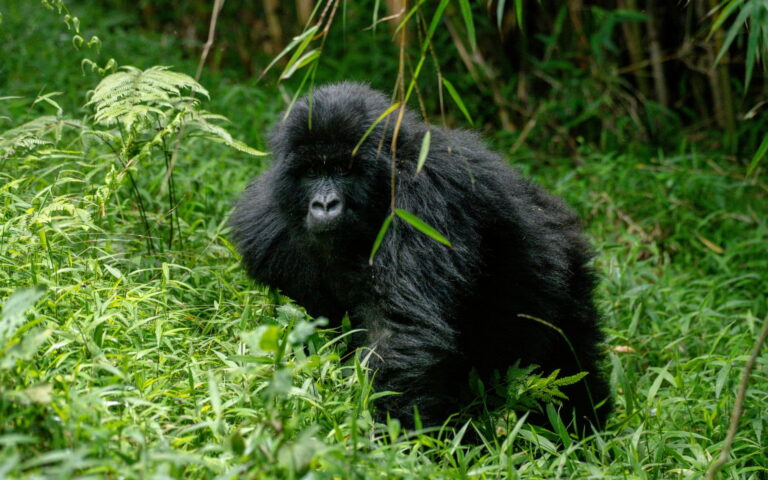
Gorilla trekking in Rwanda Volcanoes National Park is widely regarded as a “once-in-a-lifetime” event, but the physical exertion required to reach the mountain gorillas is a concern for many travelers. As these creatures inhabit high-altitude rainforests on the slopes of old volcanoes, the walk may be demanding. However, most people who are normally healthy can consider this excursion an achievable feat if they are well-prepared and have the assistance of the locals. This article explains step-by-step how challenging a hike can be and what kind of help from the park system is available to make it easier for everyone.
1. The Volcano Terrains: Steep and Slippery
The volcano terrain is the most difficult thing about trekking in Rwanda. Volcanoes National Park is composed of five main volcanoes, and the gorillas inhabit the thick vegetation on their slopes.
The Climb: The trail won’t be flat, paved or smooth. Your trek will take you through bamboo forests and dense jungle. You’ll have to get used to the ground that’s often uneven with tree roots, loose rocks, and thick vines. Since it’s a rainforest, the ground is usually muddy and slippery even if it’s dry season. A great amount of your trek will be spent stepping over fallen logs or squeezing through “tunnels” in the bamboo. Although this might sound complicated, the park rangers go ahead with machetes to clear a path, and they also move at a pace that keeps everyone safe.
2. The Altitude Factor: Thin Air at 2,500+ Meters.
The walking part might not be the hardest for many visitors it might be the breathing part that will be tough. The park which is in Volcanoes National Park is at a very high elevation.
The Breathless Hike: Most treks begin at about 2,500 meters (8,200 feet) and can ascend to 3,500 meters (11,400 feet). At such heights, the air contains less oxygen than at sea level. If you come from a city that is completely flat and has low altitude, then you might find that you get out of breath very quickly, even just on small slopes. Your heart will beat faster, and your legs will feel heavier. It is advisable to stay one or two days in Kigali or nearby Musanze before your gorilla trek to allow your body time to “acclimatize” to the higher altitude.
3. The Duration: A Short Stroll or a Long Day?
One of the difficulties in gorilla trekking is that you don’t know for sure. Since gorillas are wild animals that roam daily in search of food, the length of your hike cannot be predetermined.
The Luck of the Draw: If you are “lucky”, you might spend just 45 to 90 minutes finding your gorilla family. However, a less fortunate day could see you trekking 4 to 6 hours. It is necessary to be both mentally and physically fit to spend a long day in the jungle. Tracking the gorillas from early morning is what the park rangers’ work is all about, so they normally know very well where the gorillas can be found.
4. How the Park Helps: The “Easy” and “Tough” Groups
Rwanda is extremely well-organized in helping tourists from different fitness levels. Your lead ranger will be there to guide you throughout your trek and you will meet him or her at the park headquarters for a briefing.
Matching Groups to Fitness: The rangers will take a look at the group and ask about everyone’s fitness. If you are not young anymore or you have some minor mobility issues, you can ask for a “short” or “easy” trek. The rangers will then assign you to a gorilla family that stays close to the park boundary in flatter areas. If you are young, fit, and want to be challenged, you can ask for a “long” or “tough” trek. This might be climbing the volcanoes for a longer time. Thanks to this system, not only a few people benefit but even those with a lower fitness level can enjoy the experience.
5. Your Best Friend: The Porter
The number one tip for anyone who is worried about the difficulty of their trek is to hire a porter.
A Helping Hand: At the beginning of the hike, you can hire a local porter for a fee of 20 USD. The porter will carry your backpack, which usually has your water, lunch, and camera gear. More importantly, the porter is there to help you physically either by pulling or pushing you when the mud is deep or the hill steep. They are very strong and have lots of experience in the forest. With a porter, the hike no longer is a daunting physical challenge but instead becomes an enjoyable walk.
6. Weather and Gear: Staying Comfortable
Sometimes the weather can exaggerate the difficulty of the hike. It can rain anytime in the rainforest, and as soon as it rains, the temperature drops and the mud gets thicker.
Preparation is Key: You have to be properly geared up if you want to “easily” make a trek. Hiking boots of good quality and with decent ankle support are necessary for the slippery mud on the trail. You are also advised to wear “gardening gloves” as it will protect your hands when you get to hold branches or nettles for balance. It environmentally makes a huge difference if you wear long trousers and long-sleeved shirts because in that way you avoid getting stung by the nettles and bitten by insects. The comfort of a dry body and a good mind goes a long way in helping with the physical effort you need for the hike.
Summary: Is it for You?
Fitness Level: There is no need for you to be a sportsman or woman, but you should be fit enough to be able to walk for 3 to 4 hours on uneven ground.
The “Slow” Rule: A “pole pole” (slowly, slowly) pace is what the rangers strictly follow. They will never leave one of you behind.
Support: You have more than enough physical support available in the form of the porters and walking sticks that are provided.
In conclusion, gorilla trekking in Rwanda is a moderate physical exercise. The altitude and steepness of the slopes combined make it a “workout,” but the systematic handling by the professional park staff and the availability of helping hands through porters allow almost anyone with an adventurous spirit to get to the gorillas successfully. The instant you lay your eyes on the silverback, all the tiredness caused by the walk vanishes. Contact us for more information.