
How difficult is to trek gorillas in Uganda.
Gorilla trekking safari in Uganda, which is mainly through the dense, steep rainforests of Bwindi Impenetrable and Mgahinga National Parks, is a common way of being very rewarding but the physical side of the activity is often neglected. Moreover, it is emphasized that the trek is not a walk but a venture into harsh natural surroundings. Knowing the aspects that influence the trip’s toughness such as one’s physical condition, climatic factors, and the location of the gorillas is not only helpful in getting ready but also in gauging the situation.
1.The Terrain and Environment: Bwindi’s Impenetrable Nature
The parks of Uganda are not joking when they say it: Bwindi is truly “Impenetrable.” The natural setting is the main culprit for the challenges that follow.
Dense Vegetation and Steep Slope: Trekking in Mgahinga is done on the volcanic slopes of the Virunga Mountains, while that of Bwindi is the steep and rolling hills of the impenetrable forest area. One cannot say the trails are paths since they are mostly thick and muddy because they are not cleared so you have to cut through the dense undergrowth to proceed. Trekkers are often faced with the challenge of twisted vines, thick bushes covered in moss, and slippery ascents/descents, yet sometimes they quickly change direction and gain/lose height without anyone realizing it.
Weather Influence: The hardness of the trek is doubled during the wet seasons (March to May and October to November). The already steep slopes become slick and muddy slides as rainfall intensifies. Even in the dry season, the forest remains humid and sudden rain showers are common. Mud and slip conditions are inevitable, and thus one has to be careful with their foot placement and balance.
2.The Unpredictable Trekking Duration.
Time is one of the largest factors that determine how hard something is. The duration of the trek depends on locating gorillas because they are wild animals and always on the move.
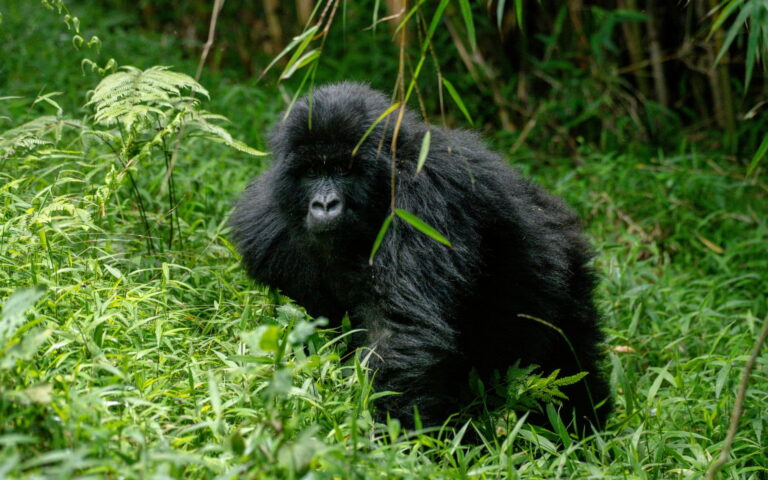
Short Treks (1 to 3 Hours): A gorilla family feeding at the base of the mountain near their nest from the previous night may result in a short and easy trek. This situation frequently occurs during the rainy season when food is abundant in the lower areas.
Long Treks (5-8+ Hours): If the family has left the vicinity of the park or has gone up to higher areas, the trip can last a whole day very easily. The less favorable condition of the trek means fewer chances of rest, nutrition, and even water, thus more weariness is experienced, and the requirement of endurance is hugely increased. Visitors must mentally prepare themselves for it, which is like a real possibility of trekking the entire day without seeing the gorillas but finally encountering them.
3. The Role of Physical Fitness and Preparation.
One doesn’t have to be a marathon runner, but a decent level of fitness is still necessary so as to derive pleasure from the trek and not get hurt.
Fitness Level Suggested: The trekkers ought to be capable of holding a hike continuous for at least 3 to 4 hours on uneven ground without coming to a stop for rest. To protect from falling and also being able to lean on the walking stick will call for the leg, the knee, and the ankle muscles to be strong. Preparing through regular activities like hiking, jogging, or brisk walking in the months leading up to the trip is very important and should not be ignored either.
Altitude: Both Bwindi and Mgahinga are high-altitude locations (Mgahinga is 2,227m to 4,127m). Decreased oxygen levels at these heights can increase bodily exertion and also, induce altitude sickness (headache, and dizziness) to some extent. So, it is advisable to get oneself accustomed to higher places for a day at a nearby town before going on a trek.
4. Essential Support Systems and Mitigation.
Support organizations like the Uganda Wildlife Authority (UWA) are on hand to ease the physical challenge of the trek.
Porters: It is extremely porters; to be very sure, the greatest are possibly the best you can do. For a relatively small amount of money (approximately US $15 to $20), women and men from the local area will not only carry your heavy backpack and camera but also support you fully. They will give you support when going up steep parts and also when coming down, thereby making the whole trip safer and greatly easier. Moreover, if you hire a porter, you be supporting the local community, which is one way of encouraging conservation.
Trekking Groups: During gorilla trekking safari you will be grouped in various groups of eight gorilla trekkers, and a family of gorillas is allocated to each group. It is even possible that the general fitness level of the trekkers can be taken into consideration to determine the difficulty, which is also determined by the park rangers’ setting the pace in order to ensure that everyone can follow. Locators are already at the site where the gorillas are, so the rangers who are taking us to them are the ones that are able to find the shortest ways through the forest by cutting them.
5. Sector-Specific Difficulty (Bwindi).
The difficulty of the different four sectors in Bwindi varies, and thus, the trekkers can select a walk that is in line with their level of physical challenge:
Buhoma (Northern Bwindi): Usually regarded as the less demanding one with more hills that go up and down and a forest that is slightly less dense.
Ruhija (Eastern Bwindi): It is characterized by its towering altitude and, mostly, longer treks.
Rushaga and Nkuringo (Southern Bwindi): Situated in the sharpest parts of the park, these two are physically the most challenging sectors that are often talked about but, offer the most spectacular views.
In conclusion, a gorilla trek in Uganda is a physically very demanding task of doubt, which requires fitness from moderate to good level as well as mental strength to withstand unpredictable weather and terrain. Still, the support to be found great local guides, reliable porters, and the one hour magic meeting with gorilla family makes it entirely worth the effort. Such a demanding trek is accessible for almost anyone in good condition if he/she is properly prepared, keeps a positive attitude, and is assisted by a porter.