


How many people are allowed to visit a gorilla family per day in Uganda.
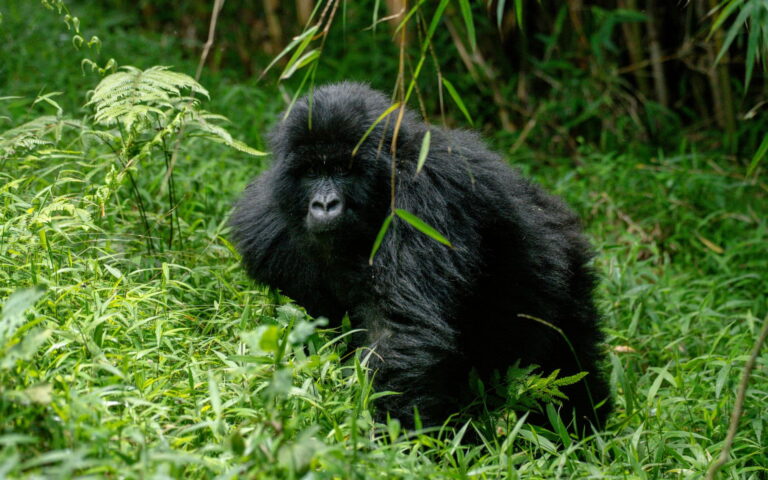
Uganda has become one of the best safari destiantions to see mountain gorillas in their natural habitat, which is mostly found within Bwindi Impenetrable National Park and Mgahinga Gorilla National Park, both of which are located in southwestern Uganda. In addition to being regarded as one of the best places to see mountain gorillas in the world, Uganda also has an excellent reputation for its conservation efforts and as such, the government has implemented strict rules and regulations regarding the number of visitors that are allowed to visit its mountain gorilla population to protect their health and also to prevent any interruption to their natural behavior and their habitat. Therefore, the foundation of Uganda’s mountain gorilla conservation initiative is a daily limit on the number of visitors that can be accommodated by each individual mountain gorilla family.
Standard Limit: 8 Visitors per Family.
Visitors who wish to experience the standard gorilla trekking experience in Uganda will know that there is a clear rule that applies equally to all habituated mountain gorilla families. Gorillas residing in Bwindi Impenetrable National Park are limited to 8 visitors per family per day, meaning that for example, if a sector within the park has 3 habituated mountain gorilla families, the total number of permits that will be issued for that sector will be 24 (3 families multiplied by 8 permits). This maximum limit is a well-established standard for gorilla tourism around the world, and it serves several important purposes to protect the mountain gorillas and their forest habitat.
After locating a particular troop of gorillas, time spent with them is limited to one hour at most. This time limit, combined with a limited number of visitors per trip (typically 8 people), has been implemented in order to decrease the impact of humans on troops of gorillas as much as possible. It also allows for troops of gorillas to operate within their normal behavior patterns (feeding, resting and socializing) without too much stress from the human visitors. Visitors have an intimate experience with the troop because the limited number of visitors makes for a less crowded encounter than would occur if the original 8 were 20-30 people.
Exclusive Gorilla Habituation Experience.
There is also an Exclusive option called Gorilla Habituation Experience (also referred to as GHE) that Uganda offers in addition to a Regular encounter. The GHE is currently only available in specific regions of Bwindi Impenetrable National Park (within the Rushaga sector) and has been designed to allow tourists to observe park researchers and trackers working with a troop of semi-habituated gorillas in a way that encourages semi-habitual gorillas to become acclimated to a safe and secured human presence.
Because the habituation of gorillas requires a lengthy time frame to succeed and because of the significant amount of time that visitors will be in very close proximity to the gorillas, the limit on the number of visitors for gorilla habitat experiences is further restricted. Only (4) visitors are allowed to visit a designated habituated family per day. The greatest advantage of the much higher fee and stricter restrictions is that participants will be granted (4) hours with the gorillas. Because this is an extended period of time, it will provide many more opportunities to observe, photograph, and understand how the families interact and how important conservation efforts are for the future of the species. Additionally, this is an intensive full day of visiting the gorillas in their natural setting, and it is the most enriching primate trekking experience available.
Conservation and Health Are of the Utmost Importance.
The main reason for the strict visitor restriction is to ensure conservation and protect the health of the mountain gorilla. Mountain gorillas share approximately thirty-eight (38%) percent of their DNA with humans. Therefore, they are very susceptible to illnesses that humans can easily transmit to them, such as common colds, flus, or even COVID-19. An ill mountain gorilla can be adversely affected due to the very low numbers of humans who visit them for conservational and touristic reasons, and that means that a simple cold can put the very fragile population of mountain gorillas at risk.
By limiting visitor groups to eight individuals (four individuals if visiting the GHE), risk for the transmission of disease is greatly reduced. With fewer people visiting the forest, there is less likelihood that an infected person will unknowingly bring a pathogen back into the forest. In addition, because of the reduced visitor numbers in each group, it is much more manageable for park rangers to control visitor traffic and ensure compliance with the seven-meter distance requirement from the gorillas. This distance serves as an important health barrier in the forest.
In addition to the disease risk, large groups of visitors cause stress and disrupt gorilla behaviors in their natural environment. Due to overcrowding in an area, gorillas will change their behavior, either by leaving or becoming disturbed. Limiting visitor numbers preserves gorilla calmness and puts gorillas in a position to demonstrate their true behavior in the wild, which is important for their long-term health and welfare.
The Gorilla Permit System: Visitor Management System.
One mechanism used to manage visitor numbers is the gorilla permit. A gorilla permit is a non-transferable ticket issued by the Uganda Wildlife Authority (UWA), which allows one person access to one habituated gorilla family for one day. Each individual gorilla family can only receive eight permits (or four permits if visiting the GHE) each day, so how many permits are available in Uganda is based directly upon the number of habituated gorilla families.
Over 20 habituated groups are present in Uganda to facilitate trekking experiences for tourists. While there are only eight individuals allowed to visit a particular group at any given time, total daily capacity is around 150-200 total tourists on average because of many different groups available to the public. Unfortunately, due to high tourism demand and limited availability, permits sell out months in advance during peak season (high season), which makes this one of the best tools for ensuring sustainable and positive impact on both gorilla species and the surrounding communities.
Conclusion: Sustainable tourism in action. One of Uganda’s strengths is its commitment to providing a limited amount of daily visitors per gorilla family. A limit of eight to visit a family for trekking, or four visitors to experience habituation, creates a viable form of sustainable, low negative impact tourism, that is of very high value. Limited visitors will lead to each traveler’s experience being uniquely memorable and provide ample opportunity for visitors to develop their connection with mountain gorillas. Limiting visitor number also helps to prevent mountain gorillas from experiencing excessive stress and possible disease transmission from visitors. Limiting visitor numbers will ensure mountain gorilla’s survival while also maintaining strong financial support for the surrounding regions of Uganda.